
Blackjack
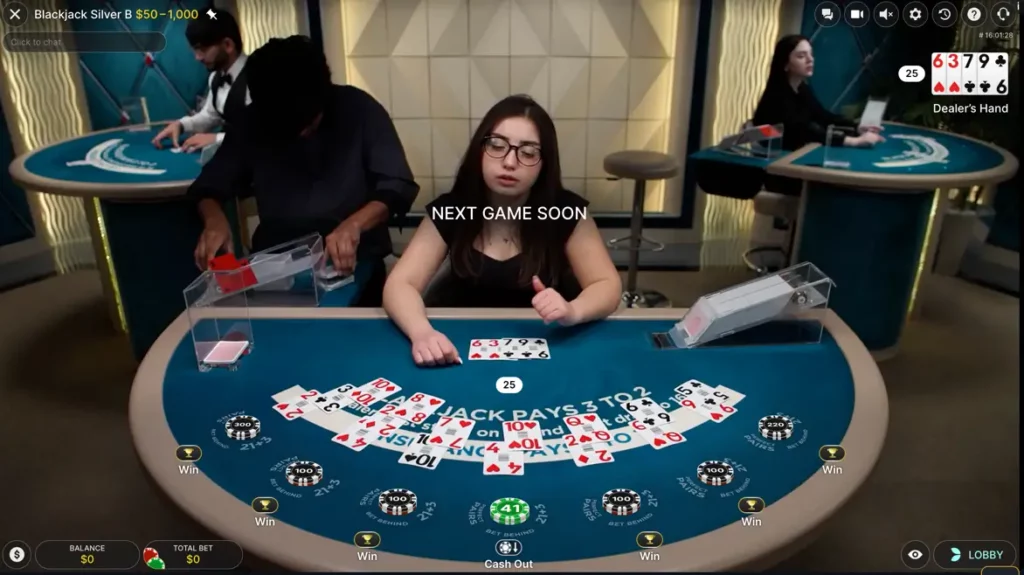
| Item | Blackjack |
|---|---|
| Game type | Card table game |
| Goal | Beat the dealer by getting closer to 21 without busting |
| Core actions | Hit, Stand, Double, Split (Surrender may exist) |
| RTP / house edge | Depends heavily on rules + strategy (check table info) |
| Most important rule | Blackjack payout (3:2 vs 6:5) |
| Best for | Players who want skill-based decisions vs a fixed dealer |
Blackjack is a casino card game where you try to build a hand closer to twenty-one than the dealer, without going over. You are making real decisions each round—when to draw, when to stop, when to double, and when to split—so the game rewards disciplined play more than most table games.
How a round works
You and the dealer receive cards, and you decide how to play your hand based on your total and the dealer’s visible upcard. If you bust (go over twenty-one), you lose immediately. If you stand, the dealer completes their hand under fixed rules, and then the totals are compared.
The key decisions
Your advantage comes from a small set of high-impact moves. Hitting and standing control whether you risk busting, doubling increases the size of a strong position, and splitting turns certain pairs into two separate hands. Surrender (when available) lets you cut losses on weak starts. These decisions matter because blackjack is one of the few casino games where optimal choices can keep the house edge low.
RTP, house edge, and what changes it
Blackjack does not have one universal RTP. The return depends on the table’s rules and how closely you follow basic strategy. The biggest “make-or-break” factor is the blackjack payout: 3:2 is standard and much better for the player than 6:5. Deck count, whether the dealer hits or stands on soft seventeen, and the doubling/splitting rules also materially affect the edge.
Basic strategy feel
You do not need complex math during play. Basic strategy is a set of consistent patterns: stand on strong totals, hit when you’re likely behind, double when one card can significantly improve your position, and split pairs that perform better as separate hands. The goal is to avoid emotional play and treat each hand as a fresh decision based on the same rules.
What to check before you play
Quick checklist (one list):
- Blackjack payout (3:2 vs 6:5)
- Number of decks
- Dealer hits or stands on soft 17
- Double rules (any two cards vs restricted totals)
- Split rules (re-splits, double after split)
- Surrender availability and any side bets